
SUSBINCO.Sustainable binders and coatings from renewable side streams
Industry–research collaboration to replace fossil-based binders and coatings with sustainable, bio-based alternatives for packaging, paints, adhesives, sealants and abrasives.
Why SUSBINCO?
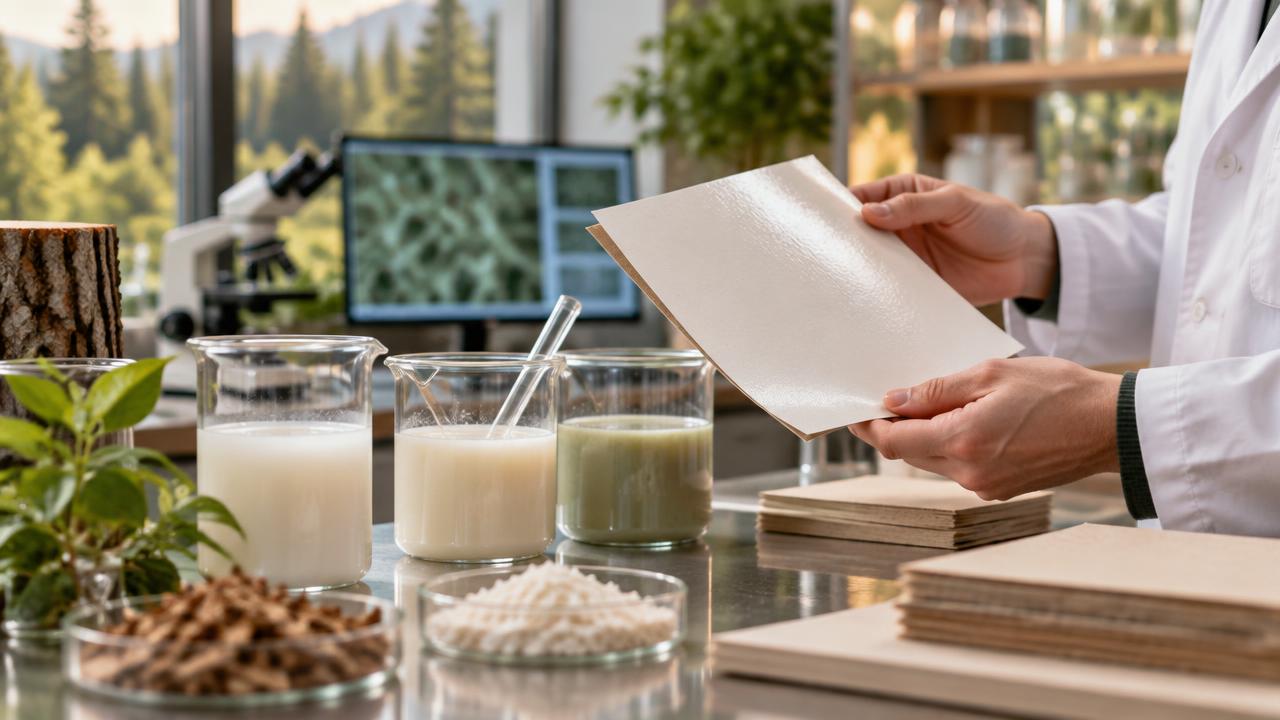
Binders and coatings are essential in products ranging from paperboard packaging and paints to adhesives, sealants, wood products and abrasives. Many conventional solutions rely on fossil-based polymers. SUSBINCO addressed this challenge by developing sustainable and safe alternatives based on renewable raw materials and industrial side streams.
The project focused particularly on forest-industry materials such as suberin from bark, lignin, hemicellulose, and nanocellulose from sawdust and pulp-industry side streams. Research organizations and companies combined expertise across the value chain — from raw-material production and formulation to pilot coating, converting, environmental assessment and end-of-life testing.
- Bio-based raw materials: Producing and characterizing suberin, lignin, hemicellulose, nanocellulose and phenolic fractions from forest-industry side streams.
- Aqueous dispersions: Developing stable, processable formulations for barrier coatings based on renewable raw materials.
- Bio-based resins: Evaluating lignin-based coatings and binders for wood, metal and abrasive applications.
- Pilot-scale application: Testing coatings on paper and paperboard and studying their convertibility on a continuous pilot line.
- Sustainability and safety: Assessing environmental impacts, biodegradability, repulpability, ecotoxicity and product safety.
- How can forest-industry side streams replace fossil raw materials?
- How can promising formulations be taken from laboratory to pilot scale?
- How can performance, safety and end-of-life requirements be considered together?
- How can industry and research accelerate the path toward commercial solutions?
SUSBINCO in numbers
Three years of industry–research collaboration — from bark and sawdust side streams to pilot-scale coatings and validated end-of-life performance.
CLIC's role: preparing and coordinating SUSBINCO
CLIC Innovation supported SUSBINCO from project preparation through implementation. Project coordination was contracted and led by CLIC Innovation, while technical research and scientific direction remained with the participating universities and research organizations — with Åbo Akademi University providing the project's scientific direction.
From renewable raw materials to pilot-scale validation
SUSBINCO demonstrated that forest-industry side streams can be transformed into functional binders and coatings — validated from laboratory formulations all the way to pilot-scale production and end-of-life testing.
Pilot-scale suberin production
Suberin production was scaled from laboratory to pilot scale. Two pilot trials produced more than 10 kilograms of suberin, distributed for formulation and testing by project partners — the final pilot batch used an 1,800-liter process.
Stable dispersions and pilot coating
The consortium developed stable aqueous suberin dispersions using commercial and bio-based stabilizers. Selected formulations were scaled to approximately 10-liter batches and applied to paper and paperboard on a continuous pilot-scale coating line, with barrier performance comparable to commercial barrier dispersions.
Bio-based coating and resin concepts
Coating concepts based on lignin, hemicellulose, nanocellulose, suberin and other forest-derived fractions were developed and evaluated — including lignin-based wood coatings with promising hardness and water resistance, and formulations for metal and abrasive applications.
Sustainability built into development
Life-cycle assessment identified environmental hotspots already during material and process development, highlighting solvent recovery, energy use, water management and process optimization on the way toward industrial production.
Safety and end-of-life
Suberin-coated paper and paperboard showed high biodegradability in tested soil and aquatic conditions. In repulpability tests, total reject remained below 1.2% for all coated materials, and twelve tested materials were reported as non-ecotoxic.
Knowledge, networks and next steps
The collaboration connected industrial partners with complementary expertise from seven research organizations, enabling shared research infrastructure, joint pilot activities and international cooperation — with 10 publications recorded in the final report.
Business potential
At project close, companies operating parallel SUSBINCO projects forecast that bio-based coatings and binders could generate more than €532 million in exports in 2030. This is a consortium business forecast — not achieved project impact — but it illustrates the commercial ambition associated with the technologies and application areas explored in SUSBINCO.
SUSBINCO final report
The full project results, methods and conclusions are compiled in the final report (PDF).
Industry and research across the value chain
SUSBINCO brought together six industrial core partners with parallel company projects, five collaborative industrial partners and seven research organizations — combining industrial application needs with research capabilities in chemistry, materials, coatings, packaging, converting, environmental assessment and safety.
Industrial core partners
With parallel company projects
- CH-Polymers
- Metsä Board
- Mirka
- Montinutra
- Teknos
- UPM-Kymmene
Collaborative industrial partners
Supporting the value chain
- Brightplus
- CH-Bioforce
- Kiilto
- MetGen
- Valmet Technologies
Research organizations
Scientific research and direction
- Åbo Akademi University
- LUT University
- Natural Resources Institute Finland (Luke)
- Tampere University
- University of Eastern Finland
- University of Oulu
- VTT Technical Research Centre of Finland